
IO Group: https://groups.io/g/DARCskynet/topics
Facebook Group: http://www.facebook.com/groups/306498286059167/
Saturday’s DARC SkyNet is at 9PM CT.
Recent Astronomical Discoveries
US military greenlights up to 100 SpaceX launches per year from California
https://img-s-msn-com.akamaized.net/tenant/amp/entityid/AA1Ox0Ql.img?w=768&h=432&m=6
Discussion Topic of the Evening
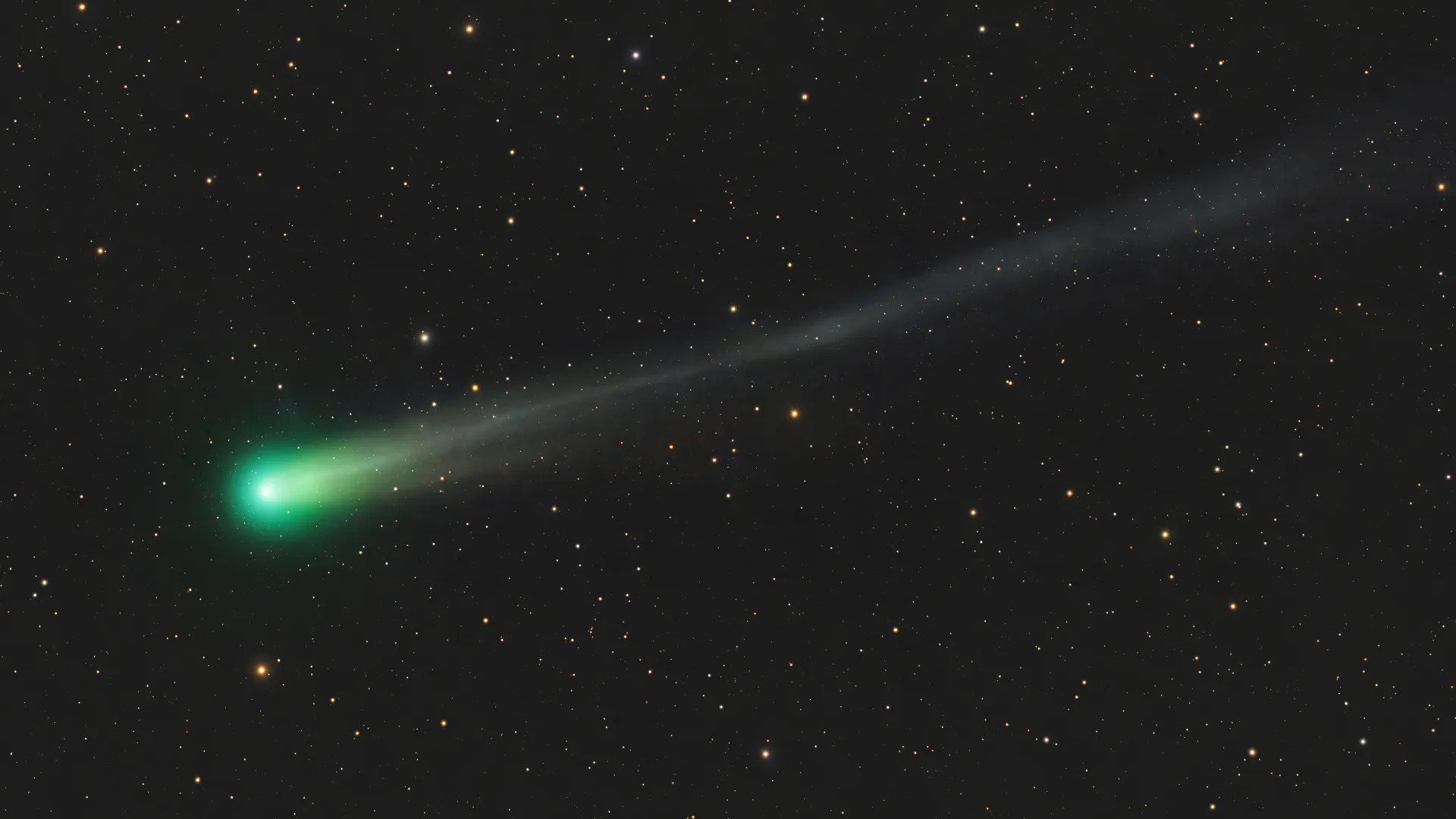
“Here Comes Comet Lemmon!”
Comet Lemmon
https://cdn.mos.cms.futurecdn.net/bYjXx4WH3uNgwvk5k7FGJ7-1920-80.jpg.webp
Comet Lemmon Near Cor Caroli – Map
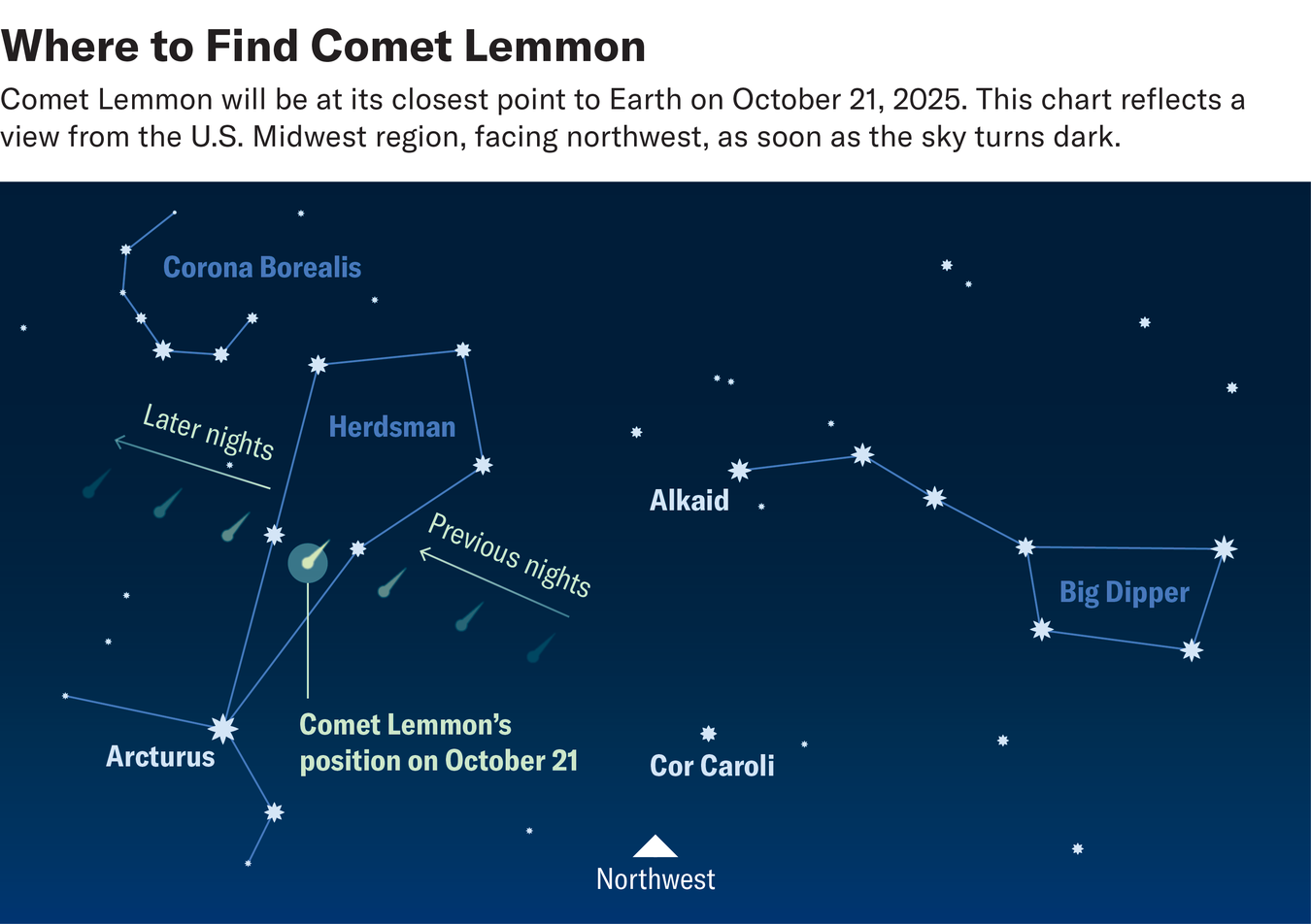
Lemmon’s Motion Through the Solar System

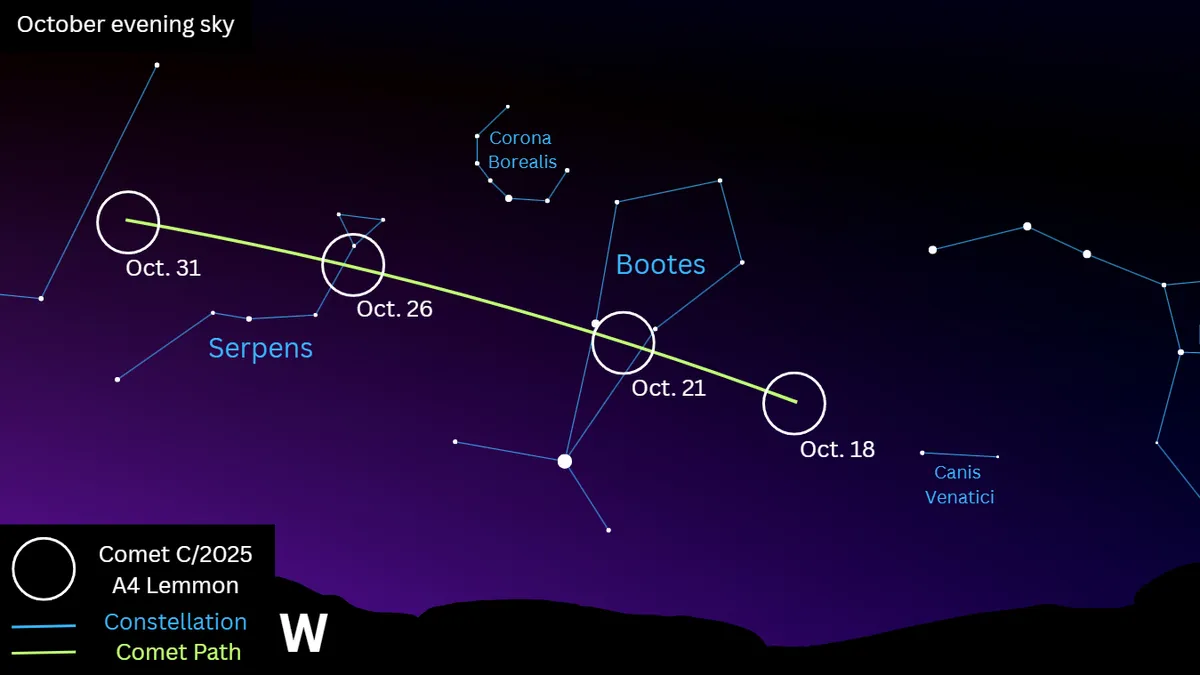
October 18 – 21 Path in the Sky
https://cdn.mos.cms.futurecdn.net/kDyeCYvqZLgH9w3ajfMvSD-1200-80.jpg.webp
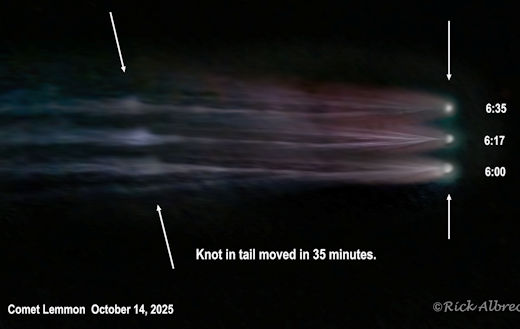
Green tail montage (Oct. 14th) by Rick Albrecht of Cumming, Georgia:
https://spaceweather.com/images2025/17oct25/action_strip.jpg
https://img-s-msn-com.akamaized.net/tenant/amp/entityid/AA1OCcu0.img?w=768&h=512&m=6
Waz Up
Space Exploration and Space History
Space Exploration News
$20 million NASA mission to visit ‘God of Chaos’ asteroid saved from budget cuts in last-minute decision
NASA’s plans to fly a spaceship alongside a potentially hazardous asteroid in 2029 will continue — for the next year, at least.
https://cdn.mos.cms.futurecdn.net/HwWJNAkE5bHTToQ2vJysin-650-80.jpg.webp
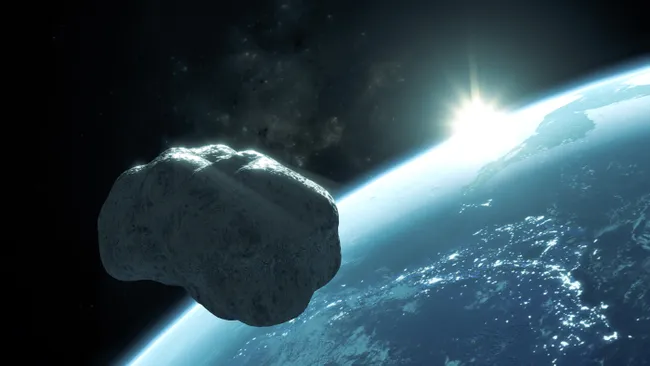
Colliding Black Holes Emitted a Massive Ringing, Confirming Predictions from Hawking and Einstein
https://cdn.mos.cms.futurecdn.net/2YWna38BTfWJyKKPY5mLFL-1600-80.png.webp
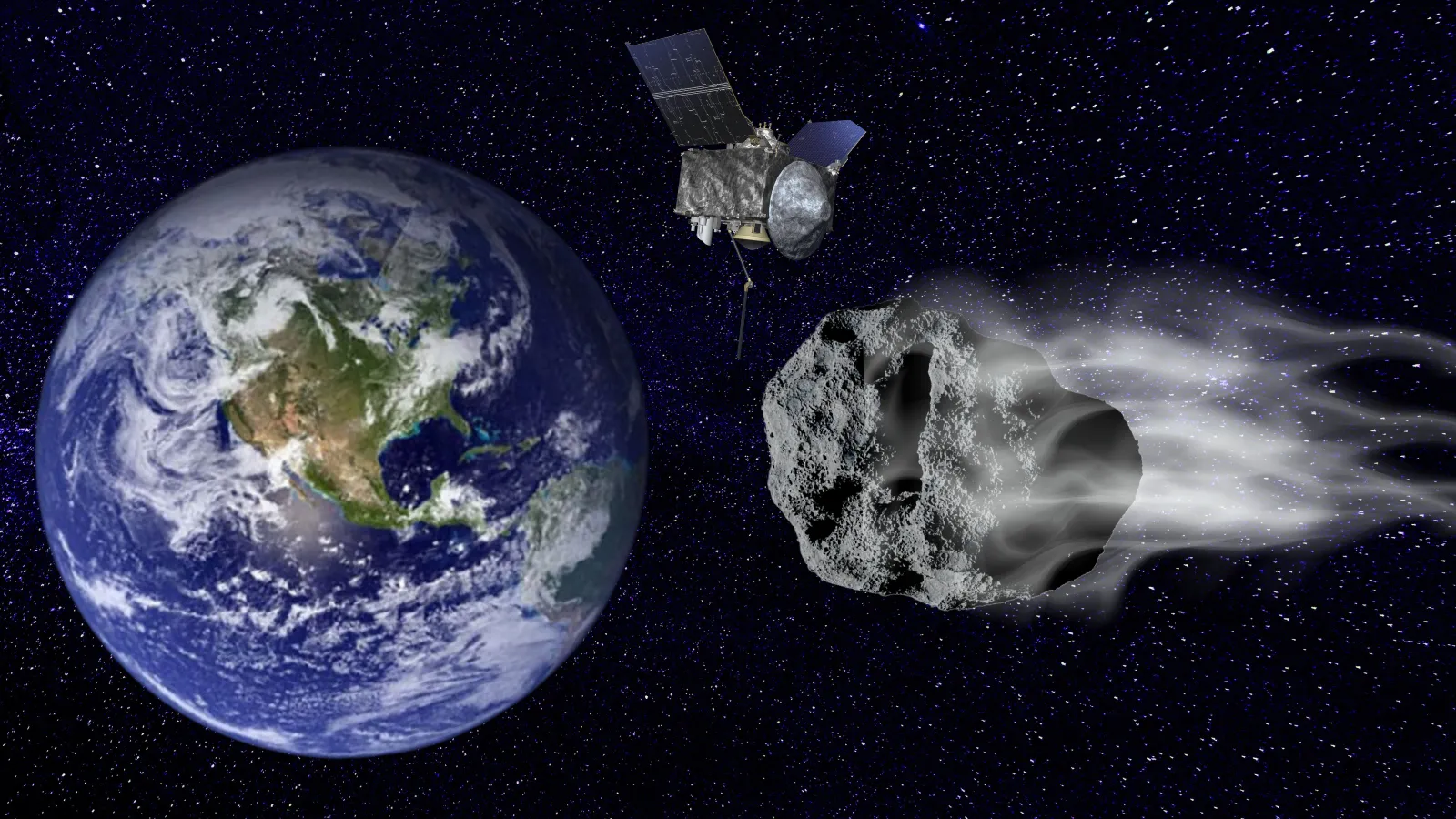
Space-Related Birthdays
Oct 12 – 18
October 13, 1952: Michael Clifford (STS-53, STS-59, STS-76)
https://upload.wikimedia.org/wikipedia/commons/d/d6/S90-46441_orig.jpg

October 13, 1962: Michael Good STS-125, STS-132)
https://upload.wikimedia.org/wikipedia/commons/4/4a/Michaelgoodv2.jpg

October 14, 1978: Kathleen Rubins (Soyuz MS-01/Exp 48-49; Soyuz MS-17/Exp 63-64; first to sequence DNA in space; Artemis Team)
https://upload.wikimedia.org/wikipedia/commons/5/51/Kate_Rubins_EMU_Portrait_%28cropped%29.jpg

October 16, 1956: James Newman (STS-51, STS-69, STS-88, STS-109)
https://upload.wikimedia.org/wikipedia/commons/0/0c/James_H_Newman.jpg
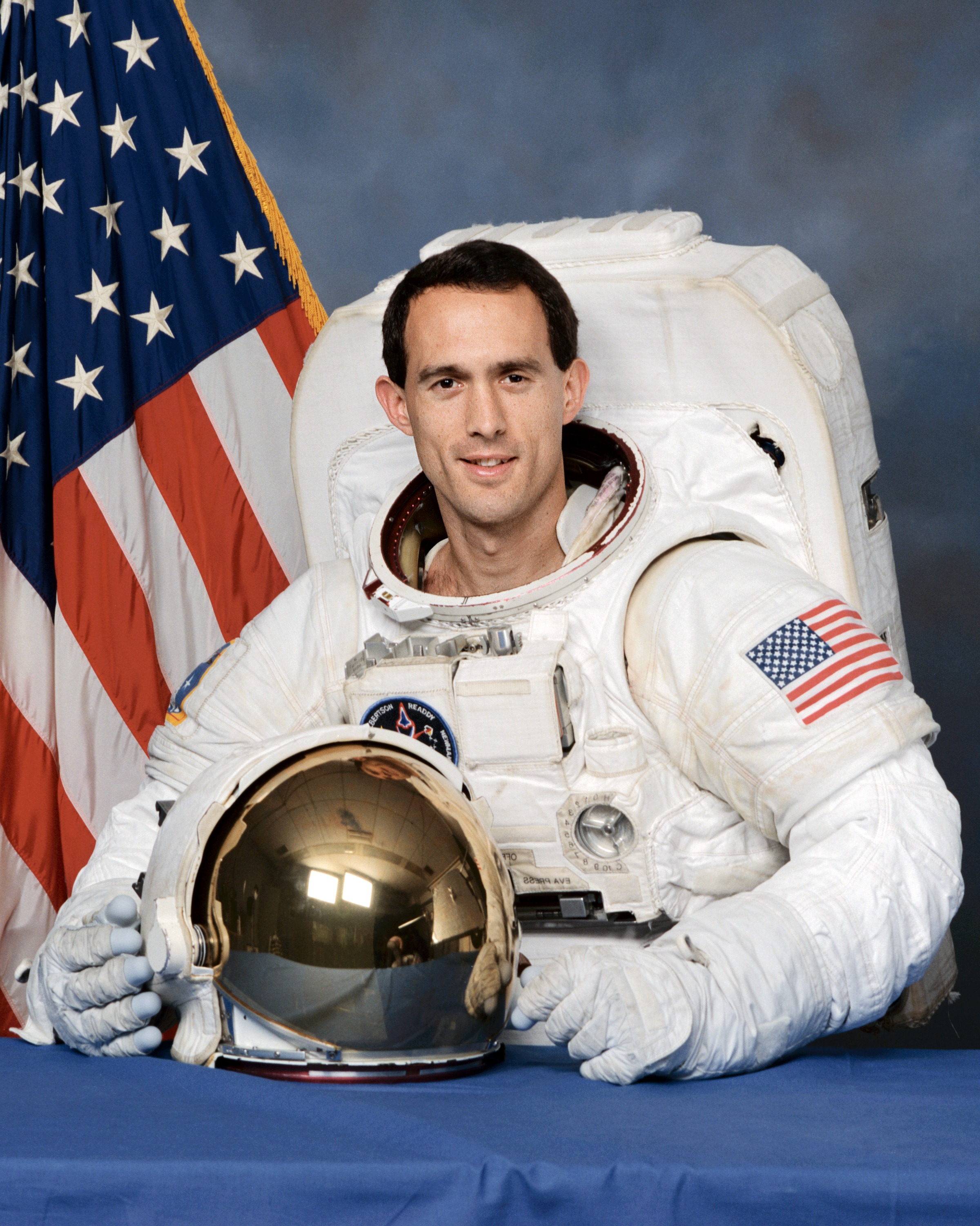
October 17, 1926: Karl Gordon Henize (STS-51-F)
https://upload.wikimedia.org/wikipedia/commons/8/80/Henize.jpg

October 17, 1933: Bill Anders (Apollo 8)
https://upload.wikimedia.org/wikipedia/commons/8/85/William_Anders.jpg
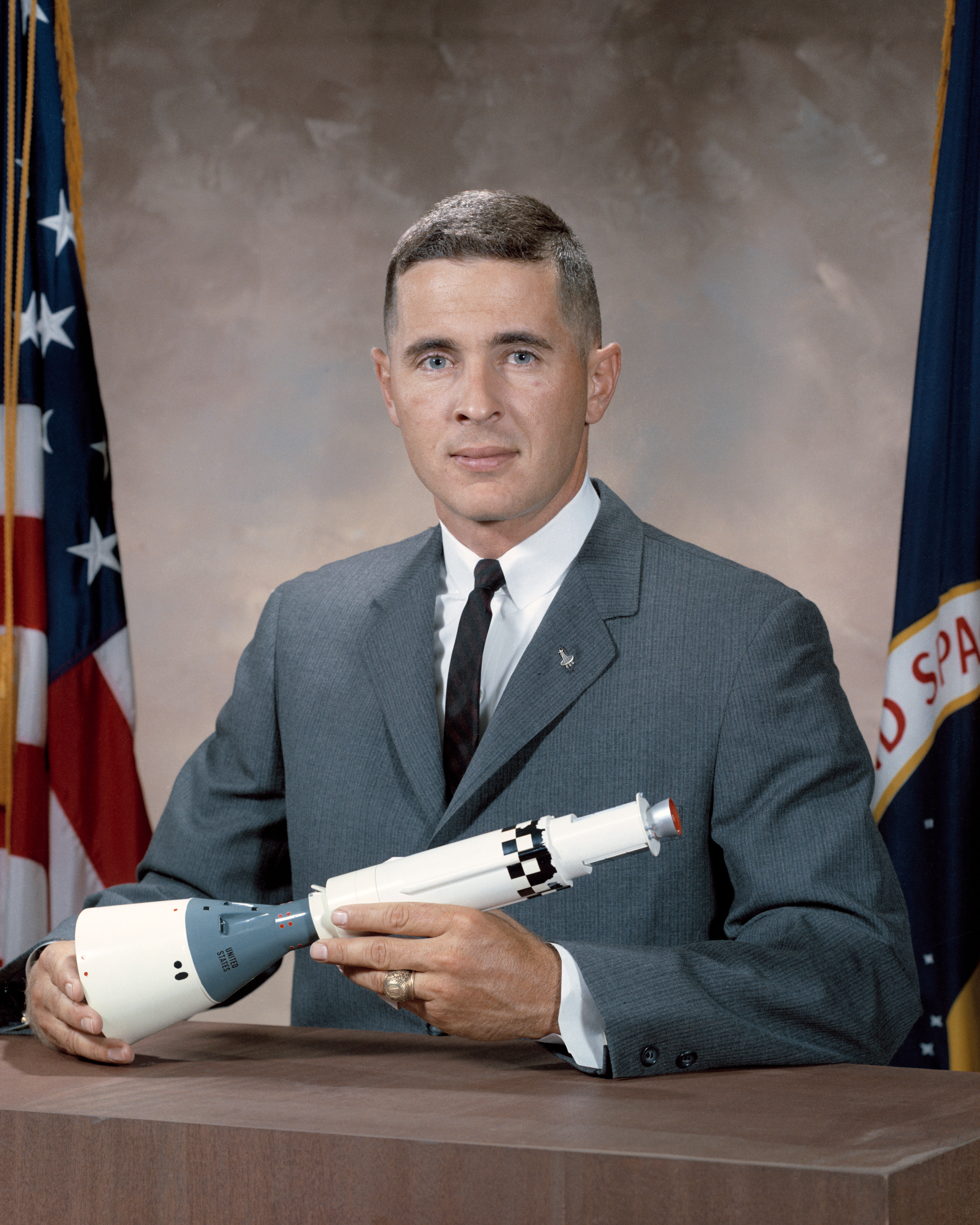
October 17, 1956: Mae Jemison (STS-47; first African American woman in space)
https://upload.wikimedia.org/wikipedia/commons/5/55/Mae_Carol_Jemison.jpg

This Week in Space History
October 12
1964: The Soviet Union launched Voskhod 1, the first spacecraft to carry a multi-person crew (three cosmonauts: Vladimir Komarov, Konstantin Feoktistov, and Boris Yegorov) into orbit. It was also the first mission flown without spacesuits.
https://www.spacefacts.de/graph/drawing/drawings2/voskhod-1_launch.jpg

October 13
1959: NASA launched Explorer 7, one of the earliest Earth science satellites, which gathered data on solar radiation, cosmic rays, and micrometeorites, and studied the Earth-atmosphere heat balance.
https://upload.wikimedia.org/wikipedia/commons/d/df/Explorer_7.jpg

October 14
1947: U.S. Air Force Captain Chuck Yeager became the first person to break the sound barrier, piloting the experimental Bell X-1 rocket-powered aircraft to a speed of Mach 1.06.
https://www.chuckyeager.org/wp-content/uploads/2016/10/MzCBB.jpg

1968: The crew of Apollo 7 transmitted the first live telecast from Earth orbit, showing views of the spacecraft interior and out of the windows.
/https://tf-cmsv2-smithsonianmag-media.s3.amazonaws.com/filer/Apollo-TV-1.jpg)
2023: An annular solar eclipse (a “ring of fire”) was visible across parts of the Americas.
https://solarsystem.nasa.gov/internal_resources/5725
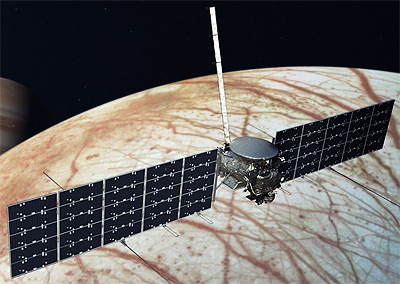
2024: NASA and SpaceX launched the historic Europa Clipper mission to Jupiter’s icy moon Europa.
https://space.skyrocket.de/img_sat/europa-clipper__2.jpg
October 15
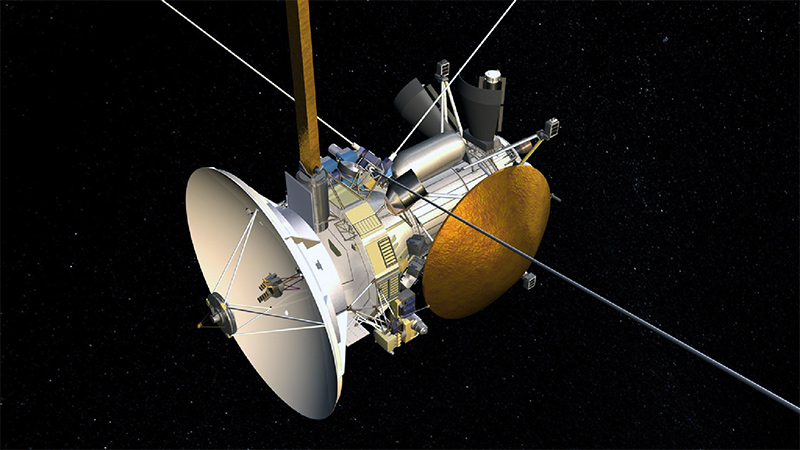
1997: The Cassini probe was launched from Cape Canaveral on a seven-year journey to Saturn, where it would conduct extensive research on the planet and its moons.
https://aerospaceamerica.aiaa.org/wp-content/uploads/2017/11/cassini.jpg
October 18
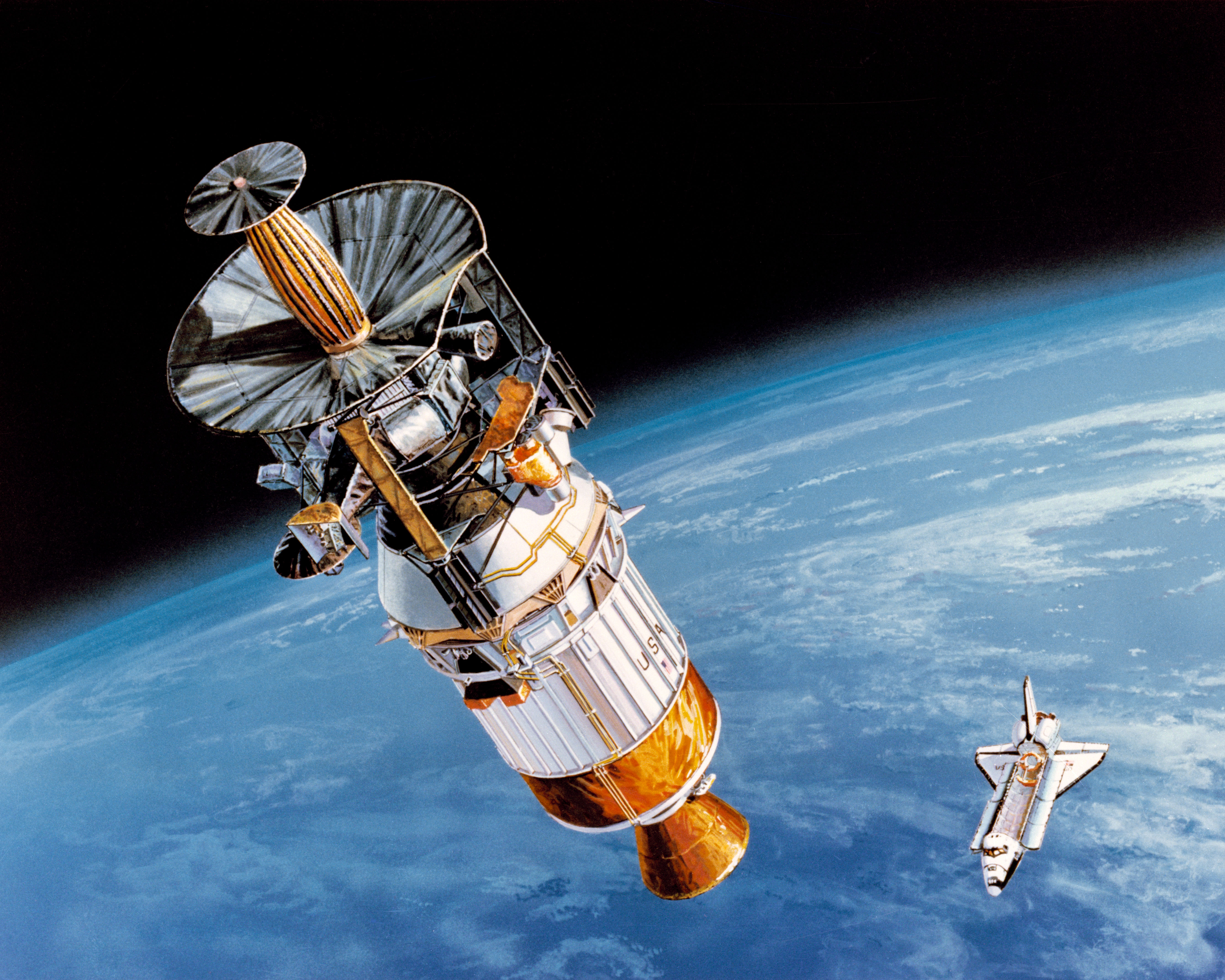
1989: The Space Shuttle Atlantis launched on mission STS-34, deploying the Galileo spacecraft on its indirect, six-year journey to Jupiter using planetary gravity assists.
Miss Carolyn’s Constellation of the Week
Constellation “Aquarius the Water Bearer”
Space Launches For This Week
Space Flight Now Launch Schedule
October 19 Falcon 9 • Starlink 10-17
Launch time: Window opens at 10:52 a.m. EDT (1452 UTC)
Launch site: SLC-40, Cape Canaveral Space Force Station, Florida
A SpaceX Falcon 9 rocket will launch 28 Starlink V2 Mini satellites into low Earth orbit. A little more than eight minutes after liftoff, the first stage booster, tail number B1067, launching for a 31st time, will land on the drone ship, ‘A Shortfall of Gravitas,’ positioned in the Atlantic Ocean. Delayed from Oct. 15. Delayed from Oct. 17. Delayed from Oct. 18.
Updated: October 13
Second half October Atlas 5 • ViaSat-3 F2
Launch time: TBD
Launch site: SLC-41, Cape Canaveral Space Force Station, Florida
United Launch Alliance will launch its Atlas 5 rocket in a 551 configuration to support the launch of Viasat’s ViaSat-3 Flight 2 satellite. The 6-ton spacecraft is designed to provide download speeds of more than 100 Mbps and operates using a Ka-band frequency. The satellite is built by Viasat on Boeing’s 702MP+ platform.
Updated: September 26
NET October 20/21 H3 • HTV-X
Launch time: 10:58 a.m. JST / 0158 UTC on Oct. 21 (9:58 p.m. EDT on Oct. 20)
Launch site: Yoshinobu Launch Complex, JAXA Tanegashima Space Center
An H3 launch vehicle, a rocket developed through a partnership between Mitsubishi Heavy Industries and JAXA (Japan Aerospace Exploration Agency), will launch the first HTV-X cargo resupply vehicle to the International Space Station.
Updated: August 29
October 21 Falcon 9 • Starlink 11-5
Launch time: Window opens at 7 a.m. PDT (10 a.m. EDT / 1400 UTC)
Launch site: SLC-4E, Vandenberg Space Force Base, California
A SpaceX Falcon 9 rocket will launch 28 Starlink V2 Mini satellites into low Earth orbit. A little more than eight minutes after liftoff, the first stage booster, tail number B1075, launching for a 21st time, will land on the drone ship ‘Of Course I Still Love You’ positioned in the Pacific Ocean. Delayed from Oct. 20.
Updated: October 15
October 22/23 Falcon 9 • Spainsat NG-2
Launch time: Window opens at 9:30 p.m. EDT (0130 UTC)
Launch site: SLC-40, Cape Canaveral Space Force Station, Florida
A SpaceX Falcon 9 rocket will launch the Spainsat Next Generation 2 (NG-2) satellite into a geosynchronous transfer orbit. It follows the launch of the Spainsat NG-1 satellite in January. These satellites were manufactured by Airbus and Thales Alenia Space on behalf of Hisdesat. Spainsat NG-2 will operate at the 29 degrees East position. SpaceX will launch this mission using the Falcon 9 first stage booster, tail number B1076. This will be its 22nd and final flight since SpaceX needs to fly this booster in an expendable configuration to use more of the rocket’s boost capabilities.
Updated: October 16
October 25 Falcon 9 • Starlink 10-21
Launch time: TBD
Launch site: SLC-40, Cape Canaveral Space Force Station, Florida
A SpaceX Falcon 9 rocket will launch 28 Starlink V2 Mini satellites into low Earth orbit. A little more than eight minutes after liftoff, the first stage booster, tail number B1077, launching for a 24th time, will land on the drone ship, ‘A Shortfall of Gravitas,’ positioned in the Atlantic Ocean. Delayed from Oct. 18. Delayed from Oct. 20. Delayed from Oct. 21. Delayed from Oct. 22.
Updated: October 14
Visible satellite passages over the next couple of days.
You can use the http://www.heavens-above.com website to find out what’s in orbit and
where to look during fly-overs
All times are “local” (Dallas) time.
ISS
Oct 18
Oct 20
Tiangong
Oct 19
Oct 23