
IO Group: https://groups.io/g/DARCskynet/topics
Facebook Group: http://www.facebook.com/groups/306498286059167/
Saturday’s DARC SkyNet is at 9PM CT.
Discussion Topic of the Evening.
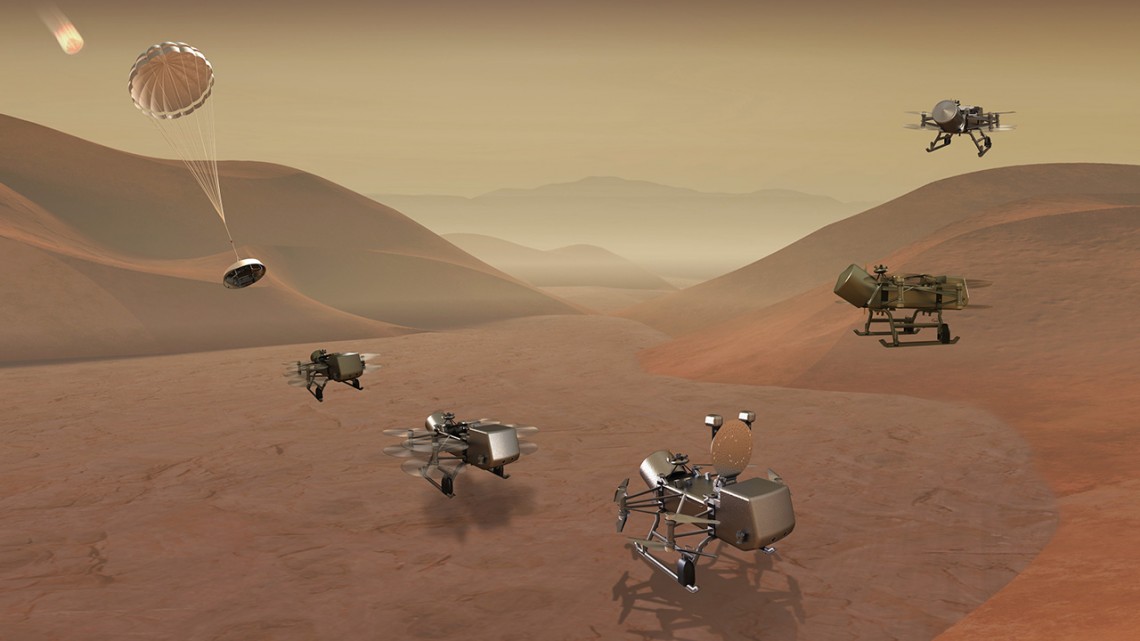
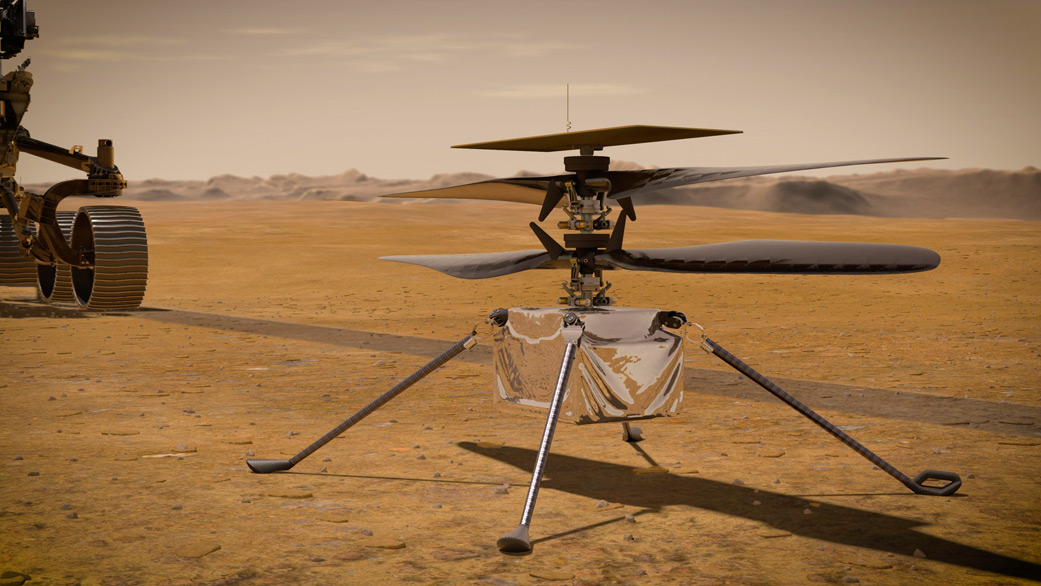
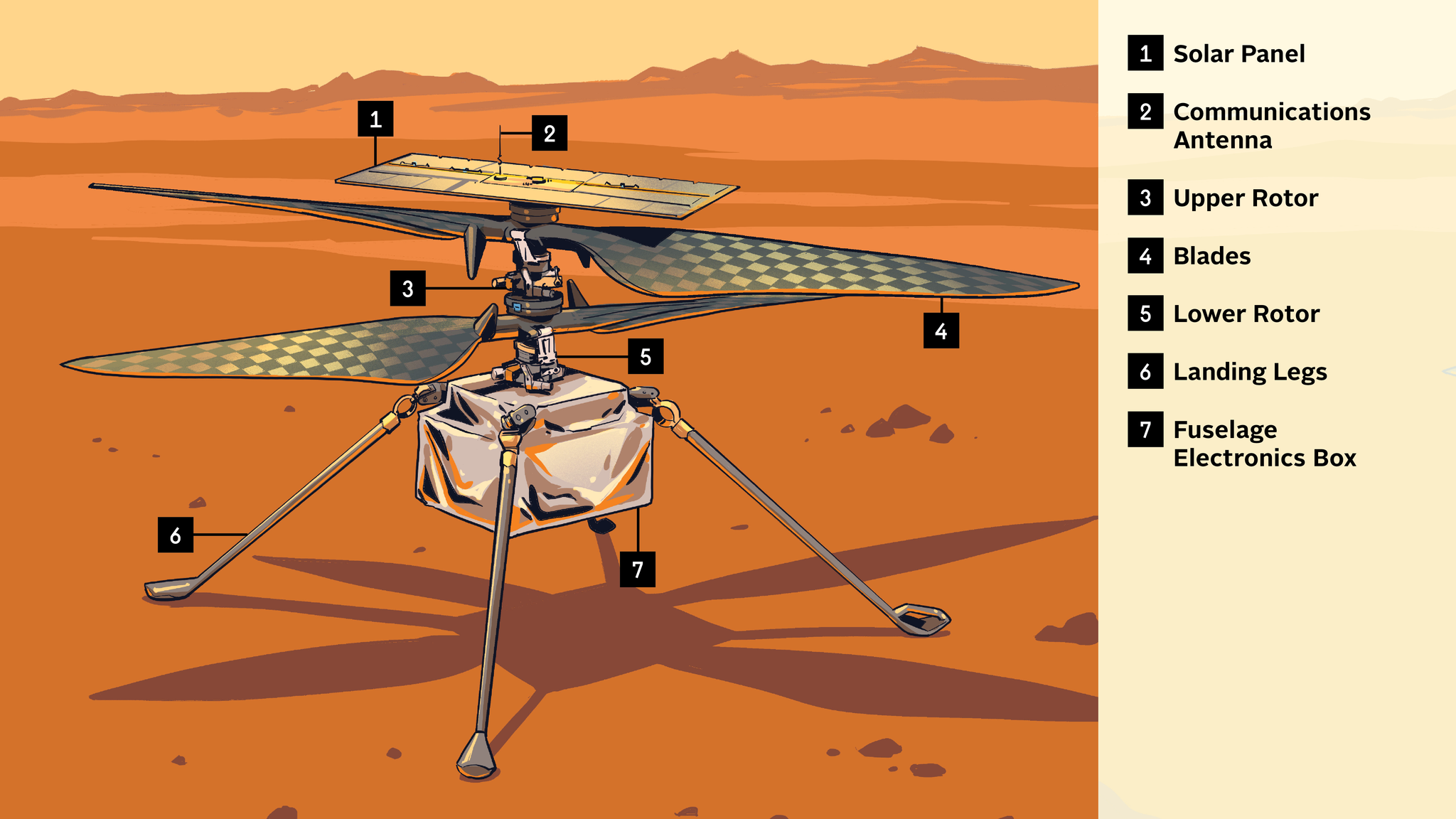
Rotorcraft on Other Worlds (Ingenuity and Dragonfly)
Dragonfly
https://upload.wikimedia.org/wikipedia/commons/a/ac/Dragonfly_spacecraft.jpg

Dragonfly Delivery on Mars
Ingenuity Deployment
https://www.nasa.gov/wp-content/uploads/2020/07/pia23720-1041.jpg
Ingenuity Callouts
Waz Up
Space Exploration and Space History
Space Exploration News
X-ray image of universe reveals almost 1 million high-energy objects: ‘These are mind-blowing numbers’
The first data released to the public from the eROSITA sky survey comprises an X-ray view of half the sky over Earth, encompassing almost a million high-energy cosmic sources, including over 700,000 supermassive black holes.
https://cdn.mos.cms.futurecdn.net/6bZS4K7bsXCbEDYTh3xfA8-970-80.jpg
Space-Related Birthdays
John M. Fabian 28-Jan-1939 STS-7, STS-51-G
https://upload.wikimedia.org/wikipedia/commons/thumb/6/6f/Fabian-jm.jpg/220px-Fabian-jm.jpg

David C. Hilmers 28-Jan-1950 STS-51-J, STS-26, STS-36, STS-42
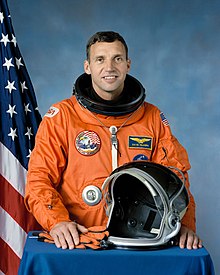
Christina Koch 29-Jan-1979 Soyuz MS-12/Soyuz MS-13 (Expedition 59/60/61), Artemis 2

Wally Funk 31-Jan-1939 NS-16

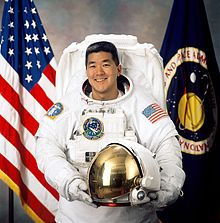
Daniel M. Tani 01-Feb-1961 STS-108, STS-120/122 (Expedition 16)
https://upload.wikimedia.org/wikipedia/commons/thumb/1/14/Daniel_Tani.jpg/220px-Daniel_Tani.jpg
Joe F. Edwards Jr. 03-Feb-1958 STS-89
https://upload.wikimedia.org/wikipedia/commons/thumb/2/28/Joe_Edwards.jpg/220px-Joe_Edwards.jpg

This Week in Space History
January 31st, Apollo 14
January 31st – on this day in 1971, NASA – National Aeronautics and Space Administration launched the
Apollo 14 mission from NASA’s Kennedy Space Center’s Launch Complex 39A.

January 28, 1986, Shuttle Challenger exploded, killing all seven crew members.
https://upload.wikimedia.org/wikipedia/commons/thumb/7/7b/Challenger_1A.jpg/170px-Challenger_1A.jpg
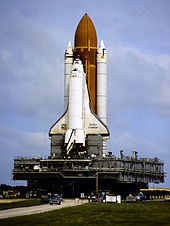
Columbia, Feb 1 2003
On Saturday, February 1, 2003, Space Shuttle Columbia disintegrated as it reentered the atmosphere over Texas and Louisiana, killing all seven astronauts on board. It was the second Space Shuttle mission to end in disaster, after the loss of Challenger and crew in 1986.

January 31, 1958 – Explorer 1
This week in 1958 (January 31), Explorer 1 became the first U.S. satellite successfully launched into space.

Miss Carolyn’s Constellation of the Week
Lepus, the Hare
8. Space Launches For This Week
Space Flight Now Launch Schedule
February 5/6 Falcon 9 • Starlink 7-13
Launch time: Approx. 5:00-10:29 p.m. PST (9:00 p.m. – 1:29 a.m. EST, 0200-0629 UTC)
Launch site: SLC-4E, Vandenberg Space Force Base, California
A SpaceX Falcon 9 rocket will another batch of 22 Starlink internet satellites from Space Launch Complex 4 East (SLC-4E). The Falcon 9’s first stage booster will land on the droneship ‘Of Course I Still Love You’ in the Pacific Ocean. Delayed from Feb. 3.
Updated: February 03
February 6 Falcon 9 • PACE
Launch time: 1:33 a.m. EST (0633 UTC)
Launch site: SLC-40, Cape Canaveral Space Force Station, Florida
A SpaceX Falcon 9 rocket will launch NASA’s Plankton, Aerosol Cloud Ocean Ecosystem (PACE) mission. The spacecraft is equipped with instruments to assess the health of the oceans by measuring the distribution of phytoplankton, tiny plants and algae.
Updated: February 01
NET February 14 Falcon 9 • IM-1
Launch time: TBD
Launch site: LC-39A, Kennedy Space Center, Florida
A SpaceX Falcon 9 rocket will launch the IM-1 mission with the Nova-C lander built and owned by Intuitive Machines. The IM-1 mission will attempt to deliver a suite of science payloads to the surface of the moon for NASA’s Commercial Lunar Payload Services program. Delayed from 3rd Quarter of 2022, December 2022, January 2023, March 2023, June 2023 and November 2023.
Updated: January 23
NET February 22 Falcon 9 • Crew 8
Launch time: TBD
Launch site: LC-39A, Kennedy Space Center, Florida
A SpaceX Falcon 9 rocket will launch a Crew Dragon spacecraft on the program’s 13th flight with astronauts. The Falcon 9’s first stage booster will return to land at Landing Zone 1 at Cape Canaveral Space Force Station. NASA astronauts Matthew Dominick, Michael Barratt, and Jeanette Epps along with Roscosmos cosmonaut Alexander Grebenkin will launch on a Crew Dragon spacecraft to begin a six-month expedition on the International Space Station. The Crew Dragon will return to a splashdown at sea off the coast of Florida.
Updated: February 01
February Falcon 9 • USSF-124
Launch time: TBD
Launch site: SLC-40, Cape Canaveral Space Force Station, Florida
A SpaceX Falcon 9 will launch a mission for the U.S. Space Force and Missile Defense Agency.
Updated: December 13
TBD Atlas 5 • USSF 51
Launch time: TBD
Launch site: SLC-41, Cape Canaveral Space Force Station, Florida
A United Launch Alliance Atlas 5 rocket, designated AV-101, will launch the USSF 51 mission for the U.S. Space Force. This mission will launch an undisclosed payload for the military.
Updated: January 15
TBD Atlas 5 • ViaSat 3 EMEA
Launch time: TBD
Launch site: SLC-41, Cape Canaveral Space Force Station, Florida
A United Launch Alliance Atlas 5 rocket, designated AV-100, will launch launch the ViaSat 3 EMEA broadband communications satellite. ViaSat 3 Americas is the second of at least three new-generation Boeing-built geostationary satellites for Viasat. ViaSat EMEA will cover the Europe, Middle East, and Africa regions. Delayed from mid-2023.
Updated: October 26
NET April 2024 Atlas 5 • CST-100 Starliner Crew Flight Test
Launch time: TBD
Launch site: SLC-41, Cape Canaveral Space Force Station, Florida
A United Launch Alliance Atlas 5 rocket, designated AV-085, will launch Boeing’s CST-100 Starliner spacecraft on its first mission with astronauts, known as the Crew Test Flight, to the International Space Station. The capsule will dock with the space station, then return to Earth to landing in the Western United States. NASA astronauts Butch Wilmore and Suni Williams will fly on the mission. The rocket will fly in a vehicle configuration with two solid rocket boosters and a dual-engine Centaur upper stage. Delayed from August and 1st Quarter of 2020. Delayed from mid-2020 after Boeing decision to refly the Orbital Flight Test. Delayed from early 2021, June 2021, and late 2021. Delayed from late 2022 to implement fixes on the Starliner spacecraft after OFT-2. Delayed from April 2023 and July 21, 2023.
Recent Astronomical Discoveries
Astronomers detect oldest black hole ever observed | ScienceDaily
Artist’s Concept – Distant Black Hole
https://d2pn8kiwq2w21t.cloudfront.net/original_images/imageswise20171206quasar20171206-16.jpg

Visible satellite passages over the next couple of days.
All times are “local” (Dallas) time.
ISS
Feb. 4
Feb. 11
Tiangong
Feb. 5
Feb. 6
Hubble Space Telescope
Feb. 6
Feb. 7
Feb. 8
Feb. 9